Black Absence in Green Spaces
Nature based Psychotherapist and Anthropologist Beth Collier explores why people of colour spend less time in nature than white communities in the UK, discussing issues of race, migration, trauma and disenfranchisement
For me there’s nothing more rejuvenating and life affirming than the simple pleasure of being in nature; amongst the company of trees and animals, looking out to a distant horizon with sweeping views of fields unfurling. Perhaps for you it’s the coast, mountains or a garden. Whatever terrain captivates you, it’s likely to feel uplifting. Why then do so few of us spend time in nature in the UK, when in countries of heritage we are typically much more connected to nature? A disconnection seems to occur in the west.
If you do enjoy walking or other activity in nature you’ve likely noticed very few other black and Asian people. Natural England reports that 25.7% of Asian, 26.2% of black and 38.8% of mixed race people spent time in nature compared to 44.2% of white people.
Our low presence matters because we miss out on the pleasures and health benefits, and are less involved in conserving and protecting green spaces.
The vast majority of the UK’s black and Asian population live within urban areas, 99.1% of Pakistanis, 98.7% Bangladeshis, 98.2% of black Africans, 97.9% black Caribbeans, 97.3% Indian and 94.2% Chinese.
I had a different formative experience, growing up in a rural area, immersed in nature, surrounded by open fields, part of only a small number of ethnic minorities living in the countryside; 6.4% of Mixed (Black/White), 1.9% of Black people and 2.6% Asian people. As I moved into cities as an adult I felt a fish out of water in trying to find connection with other people of colour who regularly seek out time in nature. There are of course a number of us, but we are a minority within a minority.
Why is this? I’ve conducted ethnographic research about people of colour’s relationships with nature in the UK, drawing from my work as a Nature based Psychotherapist and in leading reflective sessions in the woods around the campfire; exploring the role nature plays in our lives and the reasons why it may or may not feature strongly in our daily experiences.
“for many people of colour in the UK the desire to be connected with nature is strong but it’s the relationship with other humans that have made being in nature feel unsafe.”
My research has shown that the issue of our lower presence in natural settings is not simply about people of colours’ relationship with nature, but also about our relationship with other people and how we’re received and responded to in natural settings. Over two years of research revealed a pattern of experiences in which current relationships with nature are often rooted within historical messages about belonging, as well as people’s own direct experiences.
In many cases there is a causal flow of experiencing stemming from the historical experience of colonialism, slavery, our families arrival in the west and a continuing legacy affecting how our relationship with nature is navigated, including the development of cultural attitudes which shun nature; as shown in the table below in respect of the impact of relationships with humans, the impact of relationships with nature and the resulting affect on socio-cultural attitudes.
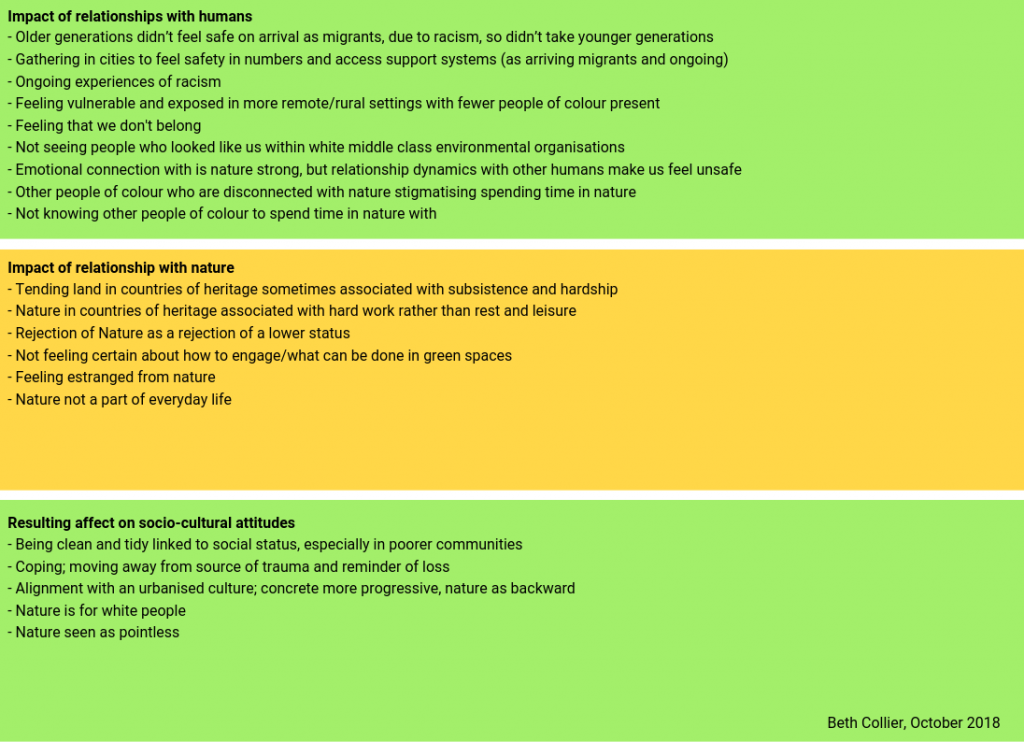
This article discusses some of the core themes impacting people of of colour’s relationships with nature in the UK.
Pressure to build new lives/Gathering for support networks
In our differing migrations we have tended to gather in cities to feel a sense of safety and community in numbers, practically we had lives to build with a focus on finding work and networks of support to sustain ourselves. There wasn’t a huge amount of time for leisure in nature. Experiences of hostility, which are hard enough to bear when you are surrounded by other people of colour, are more intimidating when you are isolated. This brought about a protective attitude in our parents and grandparents who came to see the countryside and nature in urban spaces as unsafe.
Racism
Racism is a big part of why people of colour are less present in nature. Many people of colour feel an apprehension on stepping into nature in more remote and open spaces, wondering how they are going to be received. The sense of vulnerability increases with increased visibility. A significant proportion of people had experienced or feared being stared at, snubbed, verbally assaulted, followed or physically threatened. It was a common experience for people to be made to feel their difference and that they were out of place and unwelcome, impacting on our sense of safety.
Racism as a passive aggressive projection has shaped how some of us behave in nature, creating a barrier to simple enjoyment. For example, our presence has been treated with suspicion in natural settings, some people of colour, particularly men, feel a pressure to change their behaviour to prove they are not a threat – which sabotages their own relaxation. Some worry that they are perceived as ‘up to no good’ and felt pulled into Respectability to make white people feel comfortable.. This dynamic occurs in cities but is exacerbated in frequency and intensity in areas with fewer people of colour.
Generational disconnect
Many people of colour are disconnected from nature in the UK because their parents and their grandparents didn’t feel safe to take them or had other survival preoccupations. This creates a chain of disconnect – not having adults who take us into these spaces means that time in nature isn’t normalised, rather we experience a generational loss of connection and cultural attitudes emerge for us to cope with that loss.
Loss of knowledge/lack of bridge
In countries of heritage we often learn about the natural world relationally, through conversation and experience with older relatives. In UK settings our elders may lack knowledge of wildlife and often didn’t have connections with established/white people to learn from. This breaks down the generational oral traditions for learning about the natural world. Leaving us without a bridge into knowledge about nature to familiarise practicalities such as how to keep warm/what to wear, how to get there; and relationalities such as names, characteristics and uses of wild plants; nature becomes a stranger, whereas in countries of heritage it was familiar.
Hardship and subsistence
For many people in the west time in the natural world is associated with leisure and recreation. However for some people with a recent history or lived experience of subsistence within the family, having come from rural areas in developing countries, nature can be associated with hardship and struggle in having to work the land – it is a place of survival. In coming to the west people may have a desire to leave behind lifestyles where you might get dirty and hands-on in nature, seeing their own rural background as backwards and wanting to integrate into a more urban lifestyle as an indicator of status and implied progression.
Nature as the scene of a crime
Rather than a romanticised relationship with nature as a source of relaxation, for some people of colour nature can be painfully associated with being the scene of a crime or mistreatment – whether through hard physical work, poverty, legacies of slavery, colonialism and limited options. There is a trauma in the fields, of abuse and coercion. Abandoning nature can be perceived as escaping systemic oppression associated with under development. In the UK context there can be a fear of criminality in parks, being seen by some as a place where bad things, such as drug dealing and assault, can happen.
Urbanised culture
Whereas in countries of heritage we might be very connected to nature and wildlife, and live within a culture which has developed in relationship to the natural world – when people migrate into cities an urbanized culture develops in relationship to the city. Focus turns to successfully being in a city, which is different from successfully being in nature. How we function in an urban setting and the value codes of claiming status within city contexts tends to have a greater emphasis on material consumerism; on how we present ourselves, what we own, and the kind of activities we partake in. Our understanding of these value codes are demonstrated, for example, through clean, tidy, box fresh clothes and not dirty, scuffed nature tarnished clothes; it carries a statement about identity, about what we do and what we don’t do which is connected with where we feel we belong and where we don’t feel we belong.
There are inter-twinned reinforcements about belonging. Some people of colour moving into western cities from developing countries have carried (an imposed) cultural assumption that urban is better and that progression excludes nature, parallel to this they experienced white perspectives telling them that we are unwelcome in nature.
Poverty
For people of colour who have experienced levels of poverty in the UK, families may not have a set of clothes that children are allowed to get dirty. Looking good and well turned out was important to feel a sense of self esteem and to counter anxieties about status, or ‘looking poor’. In contrast to white middle classes, without economic and status anxieties – children being dirty from outdoor play is a sign of an afternoon well spent, being healthy and productive. Even when financial circumstances improved this measure of worth often remains, getting dirty being seen as naughty or transgressive – as communities judge each other on presentation.
Shame
There is a privilege in the white middle class of being free to enjoy nature without feeling they’re having to prove that they’re separate from it. For many people of colour there is a sense of shame in being connected to nature, through our experience of colonialism and slavery which stigmatised us as having a way of life close to nature which was inferior and primitive, contrasting our poor undeveloped villages, to the west’s superior affluent technological cities.
Internalised Racism
Such racist stigmas become internalised and some may want to distance themselves from being perceived as backward, often by perpetuating self limiting myths about nature and our place in it; black people don’t do camping/hiking/skiing/swimming. These myths articulate a message that we have no business being there, that you’re mad for wanting to go, that being in nature is a sign of being mentally unwell, weird or of acting white. Trevor Noah, Walter Kamau Bell, Gina Yashere, Romesh Ranganathan all have material laughing at the absurdity of being close to nature.
Culturally there is often force in the ridicule of a desire to be in nature which disparages and serves as a coping mechanism to protect feelings about something lost or that doesn’t feel safe; dismissing and trivialising nature.
Some of the ways we insult each other connotes a relationship with nature as being a sign of inferiority; Caribbean communities taunting more recently arrived Africans as being backward having come from villages, ‘Bush woman’ being used as an insult toward other African women to suggest a lack of sophistication.
Lack of Representation
We rarely see ourselves in nature in a western context. There is a widely acknowledged lack of black and Asian representation within environmental organisations and nature based activities, we are rarely presented as knowledge holders or leaders in natural spaces, creating a feedback loop further increasing a perception that green spaces are not for us.
Disenfranchisement
Many people of colour have been disenfranchised from nature through human interference.
Our experiences of how we’re received by white others in nature and negative narratives about our connection have led to a sense that we are outsiders and unwelcome. We are less likely to feel entitled to be in natural spaces or to have a sense of ownership, feeling more of a guest in the space than it being our home. There is a colonial parallel between displacement in African and Asian contexts and disenfranchisement in the west, we’re made to feel that the land is not ours, that our presence causes harm, that we don’t belong and the impact is that we are forced off and away from nature, and separated from a source which is nourishing and sustaining.
The issue of our absence in nature isn’t simple self limiting behaviour but is linked to cultural responses to historical and current traumas of shame, hardship and racism. Consequently some people feel they’re escaping something negative and stepping into something better in cities, and whilst simultaneously being received negatively by other humans in the natural world – providing cause to see ourselves as uniquely urban in western contexts.
For those who do want to explore, being in nature can start to feel emotionally complicated – creating a barrier to just getting on with enjoying ourselves.
It is apparent that although we currently spend less time in nature than white people (in the west), for many people of colour the desire to be connected with nature is strong but in many cases it is the relationship with other humans that have made being in nature feel unsafe and out of reach.